80th Independence Day 2026: Why India Celebrates Independence Day on 15 August

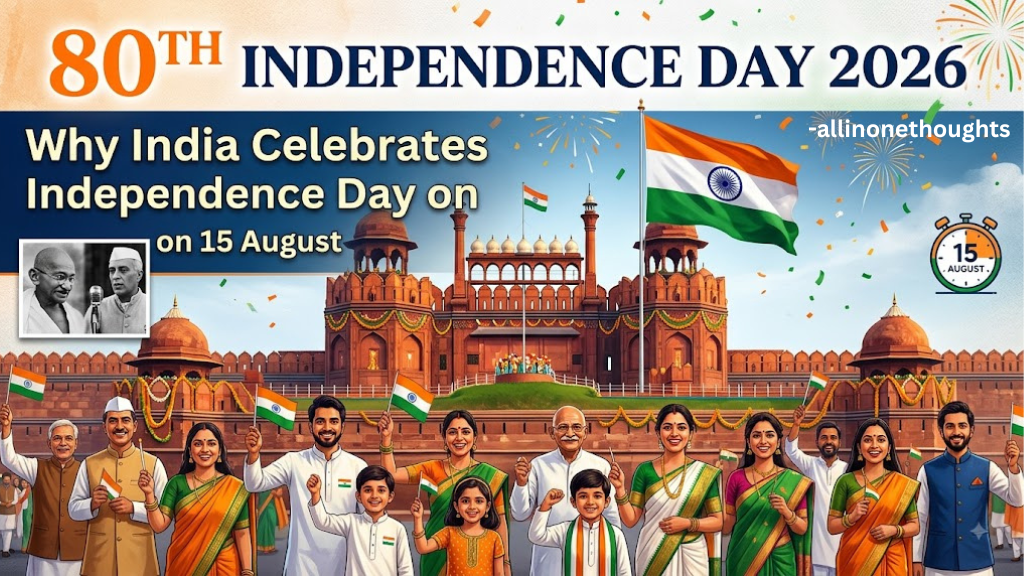
India will celebrate its 80th Independence Day on 15 August 2026. This special day marks the historic occasion when India gained freedom from British rule in 1947.

Each year, this special day helps us remember the struggles and sacrifices behind India’s independence. It also reminds us how India moved from colonial rule to becoming an independent and self-governing nation.

Independence Day is much more than a public holiday. It is a day to honour the people who contributed to India’s freedom and to understand the value and responsibility that come with it.

Why Is 2026 Called the 80th Independence Day?

Many people wonder how 2026 can be the 80th Independence Day when India became independent in 1947.

The calculation is simple. India celebrated its first Independence Day in 1947. Therefore, 1947 is counted as the 1st Independence Day, 1948 as the 2nd, and so on. Following the same sequence, 15 August 2026 will be the 80th Independence Day of India.

So, while India will complete 79 years of independence in 2026, the country will celebrate its 80th Independence Day.

Independence Day 2026

India will celebrate its 80th Independence Day on Saturday, 15 August 2026. This day marks the historic occasion when India became free from British rule in 1947.

Across the country, people will celebrate the day by hoisting the Tricolour, attending patriotic programmes, and taking part in cultural events. Schools, colleges, government offices, and various organizations will also organize speeches, competitions, and other activities to mark the occasion.

The main national Independence Day ceremony is traditionally held at the Red Fort in New Delhi. The Prime Minister unfurls the national flag and delivers an address to the nation, highlighting India’s achievements, challenges, and future goals.

However, Independence Day is not only about celebrations. It is also a time to remember the freedom fighters and ordinary citizens who contributed to India’s independence struggle and made great sacrifices for the country.

India achieved independence on 15 August 1947, ending British colonial rule. Since then, the day has remained a powerful symbol of freedom, national unity, and India’s journey as an independent nation.

Which Independence Day Is Celebrated in 2026?

India will celebrate its 80th Independence Day on 15 August 2026. The reason is that the country celebrated its first Independence Day in 1947, when it became free from British rule.

The counting goes year by year:

1947 – 1st Independence Day
1948 – 2nd Independence Day
1949 – 3rd Independence Day
1950 – 4th Independence Day
2022 – 76th Independence Day
2023 – 77th Independence Day
2024 – 78th Independence Day
2025 – 79th Independence Day
2026 – 80th Independence Day

Therefore, 15 August 2026 will mark India’s 80th Independence Day.

Independence Day vs Republic Day

Independence Day and Republic Day are both important national days, but they mark different events in India’s history.

Independence Day – 15 August:
It commemorates India’s independence from British rule on 15 August 1947.

Republic Day – 26 January:
It marks the day the Constitution of India came into effect on 26 January 1950, making India a republic.

In simple words, 15 August celebrates India’s freedom, while 26 January celebrates the establishment of India as a republic under its Constitution.

When and How Did India Become an Independent Country?

India’s independence was the result of a long and challenging freedom struggle. For many years, Indian leaders, freedom fighters, revolutionaries, and ordinary citizens worked in different ways to oppose British rule and demand freedom.

People from different parts of the country took part in this movement. Some used peaceful protests and political movements, while others chose revolutionary methods. Together, these efforts played an important role in India’s journey towards independence.

1. The Revolt of 1857

The Revolt of 1857 was one of the earliest major uprisings against British rule in India. Although the revolt was eventually suppressed, it became an important milestone in the country’s struggle against British authority.

After the revolt, the British government ended the rule of the East India Company and took direct control of India in 1858.

2. Formation of the Indian National Congress

The Indian National Congress (INC) was founded in 1885. Over time, it became an important platform for India’s growing political movement.

Many prominent leaders contributed to the development of Indian nationalism. These included Dadabhai Naoroji, Gopal Krishna Gokhale, Bal Gangadhar Tilak, and several others.

Their efforts helped increase political awareness and strengthen the demand for greater Indian participation in governance.

3. Mahatma Gandhi and the Freedom Movement

Mahatma Gandhi played a major role in India’s independence movement by promoting non-violence, peaceful protest, and mass participation.

Under his leadership and influence, several important movements took place, including:

  • Non-Cooperation Movement
  • Civil Disobedience Movement
  • Salt March
  • Quit India Movement

The Quit India Movement, launched in 1942, became one of the most important mass movements against British rule.

4. Contribution of Other Freedom Fighters

India’s independence struggle involved many leaders and groups beyond the mainstream political movements. Subhas Chandra Bose and the Indian National Army (INA) also made an important contribution to the broader freedom struggle.

Revolutionaries, social reformers, political leaders, workers, students, farmers, and ordinary citizens from different parts of India also participated in the movement in various ways.

5. India Gains Independence

After the Second World War, Britain faced growing economic and political difficulties, while the demand for Indian independence had become stronger.

Eventually, the Indian Independence Act 1947 provided the legal framework for the transfer of power. India became independent on 15 August 1947, ending British colonial rule.

However, independence came alongside the Partition of British India, which led to the creation of India and Pakistan and caused widespread displacement and suffering.

India’s independence was therefore the result of decades of struggle, sacrifice, political movements, protests, and contributions from people across the country. It was not the achievement of one person or one organization, but the outcome of a broad and complex freedom movement.

Why Did India Become Independent on 15 August 1947?

India’s independence came after a long struggle against British rule. After World War II, Britain faced serious economic and political difficulties, while the demand for India’s freedom had grown stronger.

British authorities and Indian leaders held several discussions about the future of the country. These developments eventually led to the Indian Independence Act 1947, which created the legal basis for transferring power and establishing two independent dominions—India and Pakistan.

On 15 August 1947, power was officially transferred and India became an independent nation. This marked the end of British colonial rule and the beginning of a new chapter in India’s history.

However, independence also came with the Partition of India, which caused widespread displacement, violence, and loss of life.

That is why 15 August is both a day of celebration and a time to remember the difficult journey and sacrifices behind India’s freedom.

Significance of 15 August in Indian History

15 August is one of the most important dates in Indian history. On this day in 1947, India became independent from British rule after a long and difficult freedom struggle.

The importance of 15 August can be understood through the following points:

1. Symbol of Freedom

Independence ended British colonial rule and gave India the opportunity to make its own decisions and shape its political and economic future.

2. Remembering the Freedom Fighters

Thousands of people contributed to the freedom movement. Many faced imprisonment, hardships, and even sacrificed their lives for the country. Independence Day is a time to honour their courage and contribution.

3. Unity of the Nation

India has many languages, cultures, religions, and traditions. The freedom struggle brought people together with a common goal of achieving independence. The day continues to represent unity in diversity.

4. Beginning of a New Era

Independence was not the end of India’s journey; it was the beginning of a new one. After 1947, the country focused on building democratic institutions and working towards progress in areas such as education, healthcare, development, infrastructure, and economic growth.

80th Independence Day 2026: What Makes It Special?

India’s 80th Independence Day in 2026 is an important milestone. It gives the country a chance to look back at its journey since gaining independence in 1947 and think about the road ahead.

Over the decades, India has made progress in many areas, including science and technology, education, infrastructure, digital services, space research, industry, and global cooperation.

However, Independence Day is not only about celebrating past achievements. It is also a reminder that the development of a nation is a continuous journey.

Looking Back
It is a time to remember the freedom struggle, the sacrifices of freedom fighters, and the historic events that led to independence.

Looking Ahead
It is also an opportunity to think about India’s future and the role citizens can play in creating a stronger, more developed, and prosperous nation.

In simple words, the 80th Independence Day is a chance to honour India’s past, celebrate its progress, and look forward to its future.

Theme of Indian Independence Day 2026

When discussing the Independence Day 2026 theme, it is important to separate the official Independence Day theme from other government themes announced for the year.

The Government of India’s 2026 Calendar has the overall theme “Bharat@2026: Sewa, Sushasan and Samriddhi”, which focuses on service, good governance, and prosperity. The theme for August is “Yuva Shakti, Rashtra Shakti”, highlighting the important role of young people in India’s development.

However, these themes should not automatically be called the official Independence Day 2026 theme unless the government specifically announces them for the 15 August celebrations.

Therefore, anyone looking for the Indian Independence Day 2026 theme should check official government announcements for the latest and confirmed information rather than relying on unverified sources.

How Is Independence Day Celebrated in India?

Independence Day is celebrated across India with patriotic spirit and national pride. People come together to remember the country’s freedom struggle and honour the sacrifices of those who contributed to India’s independence.

The main national celebration is traditionally held at the Red Fort in New Delhi. The Prime Minister unfurls the Tricolour and addresses the nation, highlighting India’s achievements and future goals.

Across the country, Independence Day celebrations may include:

  • Flag-hoisting ceremonies
  • Patriotic songs and performances
  • Cultural programmes
  • School and college events
  • Speeches and debates
  • Essay and drawing competitions
  • Community celebrations
  • Special programmes by government institutions

The Indian national flag becomes a prominent symbol of unity and pride during the celebrations.

The day is also an opportunity for younger generations to learn about India’s freedom struggle and remember the freedom fighters who made sacrifices for the country.

Independence Day and Republic Day: What Is the Difference?

Independence Day and Republic Day are two important national celebrations in India. Although both are important, they mark two different events in the country’s history.

Independence Day – 15 August:
It celebrates the day India gained independence from British rule in 1947.

Republic Day – 26 January:
It marks the day the Constitution of India came into force in 1950 and India formally became a republic.

The Government of India explains that independence ended colonial rule on 15 August 1947, while the Constitution’s enforcement on 26 January 1950 established the framework of India’s democratic republic.

Both days are important national occasions, but their historical significance is different.

Interesting Facts About Independence Day 2026

Here are some quick and useful facts about India’s Independence Day 2026:

Date: 15 August 2026
Day: Saturday
Occasion: India’s Independence Day
Year India became independent: 1947
Independence Day in 2026: 80th
79th Independence Day: 15 August 2025
80th Independence Day: 15 August 2026
India’s Independence: 15 August 1947
Republic Day: 26 January
Constitution came into effect: 26 January 1950
Main national celebration: Red Fort, New Delhi

Quick Fact

India became independent on 15 August 1947, and since then, this date has been observed as Independence Day every year. In 2026, the country will celebrate its 80th Independence Day.

The main national ceremony is traditionally held at the Red Fort in New Delhi, making it one of the most important events of the day.

Frequently Asked Questions About Independence Day 2026

1. Which Independence Day is celebrated in 2026?

Ans. India will celebrate its 80th Independence Day in 2026.

2. Which date is Independence Day 2026?

Ans. 15 August 2026 is India’s Independence Day.

3. Why is 15 August celebrated as Independence Day?

Ans. India became independent from British colonial rule on 15 August 1947, making the date a historic national occasion.

4. Is 2026 the 80th year of India’s independence?

Ans. There is a small distinction. India completes 79 years of independence on 15 August 2026, but the country celebrates its 80th Independence Day. This is because the first Independence Day was celebrated in 1947.

5. When did India become an independent country?

Ans. India became independent on 15 August 1947.

6. What is the theme of Independence Day 2026?

Ans. The Government of India’s 2026 Calendar carries the theme “Bharat@2026: Sewa, Sushasan and Samriddhi.” Its August theme is “Yuva Shakti, Rashtra Shakti.” These should not automatically be treated as the separately announced official Independence Day celebration theme.

7. Where is the main Independence Day celebration held?

Ans. The main national Independence Day ceremony is traditionally held at the Red Fort in New Delhi, where the Prime Minister unfurls the national flag and addresses the nation.

Conclusion

India is set to celebrate the 80th Independence Day on 15 August 2026. This special day takes us back to 1947, when India gained freedom from British rule after a long and challenging struggle.

Independence Day is not limited to flag-hoisting ceremonies and patriotic events. It is a time to remember the freedom fighters, honour their sacrifices, and understand the value of freedom.

The 80th Independence Day also gives us a chance to look at India’s progress and think about its future. Every citizen has a role to play in building a peaceful, united, democratic, and developed India.

In simple words, 15 August is a reminder of India’s freedom, the sacrifices behind it, and the journey the nation continues to make.

Share and Enjoy !

Shares
We will be happy to hear your thoughts

Leave a reply

All In One Thoughts
Logo