Dr. A.P.J. Abdul Kalam Birth Anniversary 2026: Biography, Achievements & Legacy
 All in One thoughts
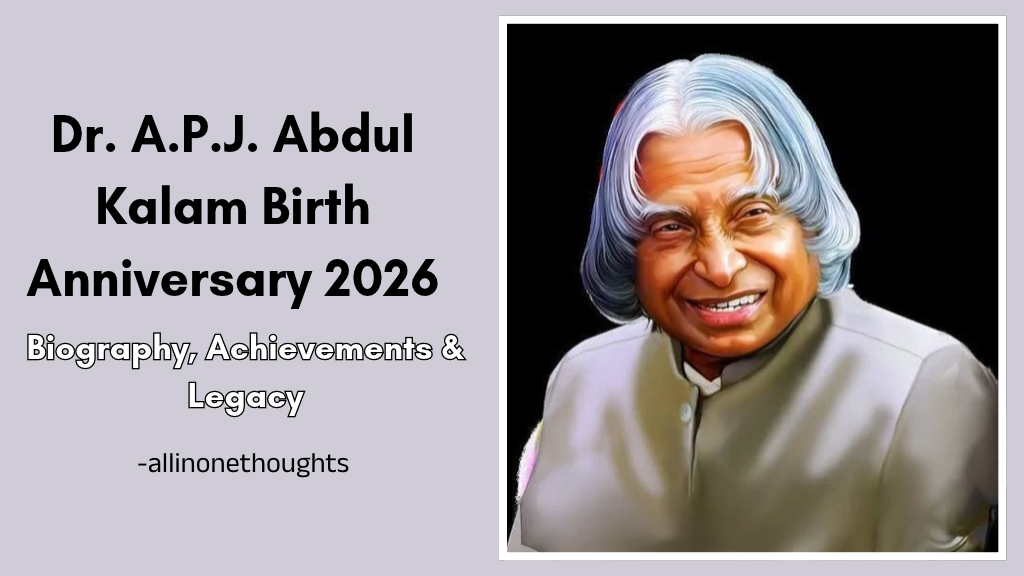
Dr. APJ Abdul Kalam was a renowned Indian scientist, dedicated educator, accomplished author, and the former President of India, admired for his valuable contributions to the nation. Popularly known as the Missile Man of India and the People’s President, he made remarkable contributions to India’s space research, defence technology, education, and national development. His inspiring journey encourages students, aspiring professionals, and individuals to pursue their goals with determination, consistent effort, and a strong work ethic.
Every year, 15 October is observed as the birth anniversary of Dr. Kalam. In 2026, India will commemorate his 95th birth anniversary, remembering his achievements, values, and vision for a developed nation.
This article covers Dr. APJ Abdul Kalam’s biography, childhood, education, scientific career, major achievements, presidency, awards, famous books, and the importance of his birth anniversary.
Dr. APJ Abdul Kalam Birth Anniversary 2026
Dr. APJ Abdul Kalam’s birth anniversary is celebrated on 15 October every year. He was born on 15 October 1931 in the coastal town of Rameswaram, located in Tamil Nadu, India. His contributions to science, technology, education, and public service made him an important figure in modern Indian history.
The year 2025 marked his 94th birth anniversary, while 2026 marks his 95th birth anniversary. On this occasion, people remember his dedication to the country and his belief that young people can help build a stronger and more developed India.
His birthday is also widely associated with the celebration of World Students’ Day, reflecting his lifelong commitment to education and inspiring young minds. His interactions with students and his encouragement of curiosity made him a role model for generations.
Schools, colleges, educational institutions, and organisations may observe the occasion through speeches, essay-writing competitions, discussions, and activities focused on science and innovation.
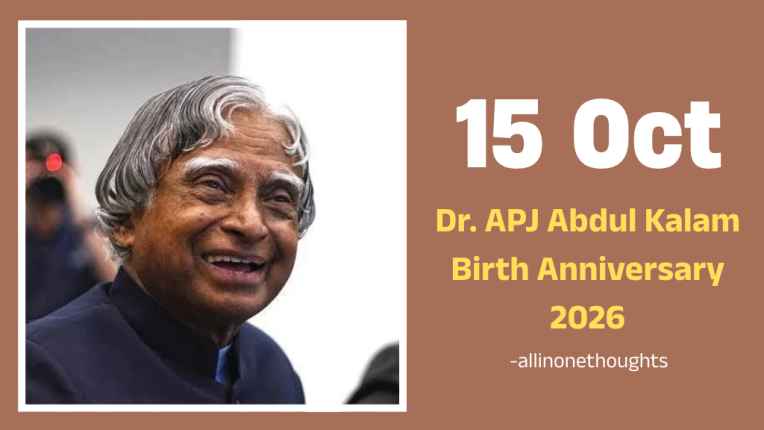
Who Was Dr. A.P.J. Abdul Kalam?
Avul Pakir Jainulabdeen Abdul Kalam was a distinguished Indian aerospace scientist and public figure who held the office of India’s 11th President from 2002 to 2007.
Before becoming President, he spent several decades working in India’s scientific and defence research programmes. His work at the Indian Space Research Organisation (ISRO) and the Defence Research and Development Organisation (DRDO) contributed to the development of India’s space capabilities and indigenous missile technology.
Unlike many public figures, Dr. Kalam was widely admired for his simple lifestyle, humble personality, and strong connection with students. Even after becoming President, he continued to encourage young people to pursue education, develop scientific thinking, and contribute to society.
His journey from a modest family in Rameswaram to the highest constitutional office in India remains an inspiring example of perseverance, learning, and public service.
Early Life and Family Background
Dr. A.P.J. Abdul Kalam was born into a family in Rameswaram, a coastal town in Tamil Nadu. His father, Jainulabdeen, was known for his simple way of life, while his mother, Ashiamma, cared for the family.
His family did not have great financial resources, and Kalam learned the value of discipline, responsibility, and hard work from an early age. As a young boy, he helped support his family by distributing newspapers while continuing his education.
These early experiences taught him to respect work and remain focused on his goals. His childhood was not marked by luxury, but it helped develop the determination and practical outlook that later shaped his career.
Kalam also developed an interest in learning about the world around him. He was curious about science, flight, and technology. His interest in these subjects eventually guided him toward a career in aerospace engineering.
His early life demonstrates that a person’s circumstances do not have to determine their future. With consistent effort, education, and determination, it is possible to move beyond limitations and pursue ambitious goals.
Education of Dr. APJ Abdul Kalam
Education played a major role in Dr. Kalam’s life. He completed his school education in Tamil Nadu and went on to study physics at Saint Joseph’s College in Tiruchirappalli.
After completing his physics degree, he pursued aerospace engineering at the Madras Institute of Technology. This specialised education provided the technical foundation for his future work in aviation, rocket technology, and defence research.
Kalam’s educational journey shows the importance of choosing a field based on interest and working consistently to develop the necessary skills.
He did not become successful overnight. His progress came through years of study, practical experience, teamwork, and learning from challenges. His story encourages students to take their education seriously and remain open to new ideas.
For young people interested in science, engineering, research, or innovation, his career is a useful example of how academic knowledge can be applied to solve real-world problems.
Dr. APJ Abdul Kalam's Scientific Career
Dr. Kalam began his professional career in India’s scientific establishment and later worked with two major national organisations: ISRO and DRDO.
His contributions to these institutions helped strengthen India’s capabilities in space exploration, launch vehicles, and missile development.
Contribution to ISRO
The Indian Space Research Organisation played an important role in Dr. Kalam’s scientific journey. He became closely involved in the development of India’s indigenous satellite launch vehicle programme.
One of his most notable achievements was serving as Project Director of the Satellite Launch Vehicle-III (SLV-III). In July 1980, the launch vehicle successfully deployed the Rohini satellite into an orbit close to Earth.
This achievement was an important milestone in India’s space programme because it demonstrated the country’s growing ability to launch satellites using its own technology.
The experience gained through this programme supported the development of India’s future launch vehicle capabilities. Kalam’s work also contributed to the evolution of the country’s launch vehicle programme, including efforts associated with the Polar Satellite Launch Vehicle (PSLV).
His time at ISRO helped establish his reputation as a scientist who could combine technical understanding with effective team leadership.
Contribution to DRDO
Following his tenure at ISRO, Dr. Kalam assumed key roles at the Defence Research and Development Organisation (DRDO), where he contributed to India’s defence research and technological development.
He became closely associated with the Integrated Guided Missile Development Programme (IGMDP), which aimed to strengthen India’s indigenous missile technology.
His contributions helped advance India’s missile programmes, including the development of systems such as Agni and Prithvi. These programmes represented significant efforts to build domestic technological capabilities in the defence sector.
Because of his contributions to missile development and launch vehicle technology, Dr. Kalam became widely known as the Missile Man of India.
His achievements demonstrated the value of research, collaboration, engineering expertise, and long-term investment in scientific development.
Role in India's Nuclear Tests
Dr. Kalam also played a significant scientific and organisational role in India’s Pokhran-II nuclear tests in 1998, working with the Department of Atomic Energy and other scientific teams.
The tests were a major event in India’s strategic and defence history. Dr. Kalam’s participation highlighted his broader role in advancing India’s scientific research and technological capabilities.
Dr. Kalam’s professional journey extended across several areas of science and technology. He worked across space research, missile technology, defence systems, and national development initiatives.
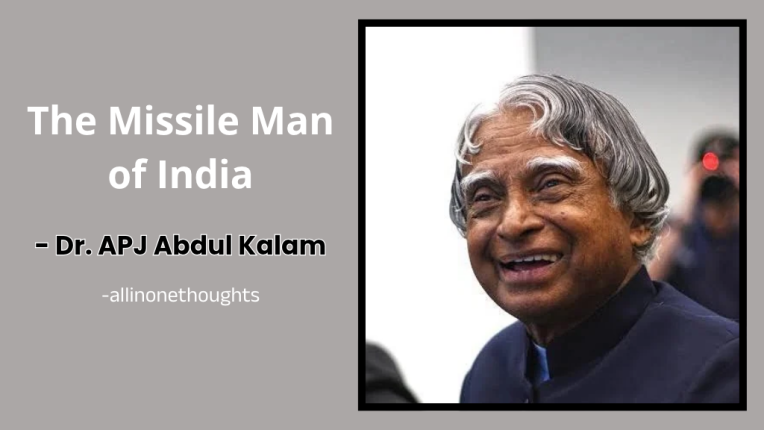
Why Is Dr. APJ Abdul Kalam Called the Missile Man of India?
The title “Missile Man of India” is associated with Dr. Kalam because of his important contributions to indigenous missile development and launch vehicle technology.
During his career at DRDO, he helped guide programmes that supported the development of missile systems, including Agni and Prithvi. His earlier work on India’s SLV-III also contributed to the country’s progress in space technology.
These achievements helped improve India’s ability to develop advanced technologies within the country.
However, his success was not the work of one person alone. Scientists, engineers, technicians, research institutions, and government organisations contributed to these programmes. Kalam’s role as a leader and coordinator helped bring teams together around challenging national projects.
His nickname reflects his contribution to science and defence, but his legacy extends much further. He is also remembered as a teacher, author, mentor, and President who encouraged young people to dream ambitiously.
Dr. A.P.J. Abdul Kalam as the President of India
Dr. Kalam became the 11th President of India on 25 July 2002 and served until 25 July 2007.
His presidency was distinctive because he came from a scientific background rather than a conventional political career. His election brought attention to the role of science, education, innovation, and youth development in the country’s future.
He was popularly called the “People’s President” because of his approachable personality and his efforts to connect with ordinary citizens, particularly students.
During his presidential term, he continued to emphasise national development, technological progress, education, and the importance of young people in shaping India’s future.
He believed that the country could achieve greater progress by improving education, strengthening research, developing infrastructure, and encouraging innovation.
Even while holding a high constitutional office, he maintained a relatively simple public image. His speeches and interactions often focused on responsibility, hard work, national development, and the power of knowledge.
After completing his presidential term in 2007, Kalam returned to academic and public activities. He continued delivering lectures, meeting students, and promoting education until the final days of his life.
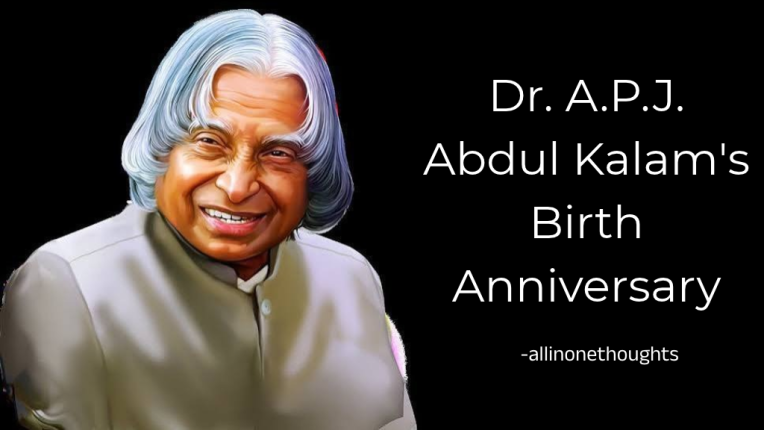
Dr. A.P.J. Abdul Kalam's Vision for a Developed India
One of Dr. Kalam’s major goals was to help India become a developed nation. He discussed this vision in his book India 2020: A Vision for the New Millennium and through his work on national development planning.
His vision focused on using science, technology, education, and human resources to improve the country’s economic and social conditions.
He believed that development should involve more than economic growth. It should also include better access to education, improved healthcare, technological advancement, rural development, and opportunities for young people.
Kalam encouraged India to strengthen its scientific capabilities and reduce unnecessary dependence on imported technology. He also highlighted the importance of agriculture, infrastructure, energy, and innovation.
His ideas remain relevant to discussions about entrepreneurship, skill development, research, digital technology, and sustainable national growth.
For him, a developed India was not simply a government responsibility. He emphasized that building a developed nation requires the collective efforts of students, educators, researchers, entrepreneurs, farmers, and every member of society.
Major Awards and Honours
Dr. A.P.J. Abdul Kalam received several prestigious awards in recognition of his scientific contributions and public service.
Some of his most notable honours include:
- Padma Bhushan (1981): Dr. Kalam received this prestigious Indian civilian honour in recognition of his valuable contributions and distinguished service.
- Padma Vibhushan (1990): Awarded in recognition of his important contributions to the nation.
- Bharat Ratna (1997): India’s highest civilian award, presented to him before he became President.
- Honorary doctorates: He received honorary degrees from numerous universities and academic institutions in recognition of his work and achievements.
These honours reflect the impact of his work across science, technology, defence research, and national development.
Although awards recognised his professional achievements, his lasting popularity also came from his humility, approachability, and willingness to guide young people.
Famous Books Written by Dr. A.P.J. Abdul Kalam
Dr. Kalam was not only a scientist and President but also an influential author. His books helped readers understand his personal journey, his ideas about education, and his hopes for India’s future.
Some of his best-known books include:
1. Wings of Fire
Wings of Fire is an autobiography that describes Kalam’s early life, education, professional journey, and experiences in India’s scientific institutions.
The book offers insights into his challenges, achievements, and the people who influenced his life. It is often recommended to students and readers looking for motivation.
2. India 2020: A Vision for the New Millennium
This book presents Kalam’s ideas about transforming India into a developed nation. It discusses the importance of technology, education, agriculture, infrastructure, and national planning.
The book encourages readers to think about India’s long-term development and the role of innovation in achieving it.
3. Ignited Minds
Ignited Minds: Unleashing the Power Within India focuses on the potential of young people and the importance of education, confidence, and national responsibility.
Kalam believed that students could contribute significantly to India’s future if they were encouraged to think creatively and work toward meaningful goals.
4. My Journey
My Journey: Transforming Dreams into Actions shares experiences and lessons from Kalam’s life. It highlights values such as determination, learning, discipline, and the willingness to overcome difficulties.
His books continue to attract readers because they combine personal experiences with practical lessons about education, work, and life.
Dr. A.P.J. Abdul Kalam's Inspirational Lessons
Dr. Kalam’s life offers several lessons that can be applied to education, professional development, and personal growth.
1. Believe in the Power of Dreams
Kalam encouraged young people to have clear ambitions and work toward them. A dream becomes meaningful when it motivates a person to learn, plan, and take action.
2. Never Stop Learning
His own journey involved continuous learning and adapting to new scientific challenges. Students and professionals can follow this example by developing their skills and staying curious.
3. Treat Failure as a Learning Opportunity
Scientific research often involves experiments that do not produce the expected results. Kalam’s career demonstrated the importance of learning from setbacks and continuing to improve.
4. Work with Discipline and Dedication
Long-term achievements require patience and consistent effort. Kalam’s scientific career showed that complex goals can be approached through teamwork, preparation, and disciplined work.
5. Use Knowledge to Help Society
Kalam believed that education and technology should contribute to human welfare. His example encourages people to use their abilities to solve problems and support their communities.
6. Stay Humble Despite Success
Even after reaching the highest constitutional office in India, Kalam remained known for his simple lifestyle and interest in students. His life reminds us that professional success and humility can go together.
How Is Dr. A.P.J. Abdul Kalam's Birth Anniversary Celebrated?
Dr. Kalam’s birth anniversary provides a chance to celebrate his achievements and share his inspiring vision and values with younger generations.
Schools, colleges, and other organisations may commemorate the occasion by arranging various programmes based on their schedules and local customs.
Common ways to observe the occasion include:
- Arranging speeches and interactive sessions highlighting his life journey, major accomplishments, and contributions to India.
- Conducting essay-writing, quiz, and debate competitions.
- Arranging science exhibitions and innovation activities.
- Reading passages from his books and discussing their lessons.
- Sharing educational messages that encourage students to pursue their goals.
- Holding activities focused on scientific curiosity, leadership, and social responsibility.
- Remembering his contributions to space research, missile technology, and education.
Students can also celebrate the day by learning about India’s scientific progress, exploring careers in science and engineering, or developing a project that addresses a real-world problem.
The most meaningful tribute is to put his values into practice by learning continuously, working honestly, and using knowledge for the benefit of others.
World Students' Day and Dr. Kalam
15 October is also widely observed as World Students’ Day in recognition of Dr. Kalam’s association with students and education.
He believed that young people were an important part of India’s future. Throughout his life, he visited educational institutions, delivered lectures, and encouraged students to ask questions and develop independent thinking.
He did not see education as a process limited to textbooks or examinations. For him, it was a way to build confidence, creativity, responsibility, and the ability to solve problems.
His connection with students became one of the most recognisable parts of his public life. Even as President, he made time for young people and continued to speak about their potential.
World Students’ Day provides an opportunity to discuss the importance of accessible education, good teachers, practical learning, scientific thinking, and opportunities for young people.
Students can honour Kalam’s legacy by setting realistic goals, developing useful skills, respecting their teachers, and contributing positively to their communities.
The Final Days and Lasting Legacy of Dr. Kalam
Dr. A.P.J. Abdul Kalam died on 27 July 2015 while addressing students at the Indian Institute of Management in Shillong, Meghalaya.
He was engaged in teaching and interacting with students until the end of his life. His passing was widely mourned across India and internationally.
Although he is no longer with us, his contribution to Indian science, defence research, education, and public life remains significant.
His legacy can be seen in the continued interest in indigenous technology, scientific research, educational initiatives, and the encouragement of young innovators.
He is remembered not only for his work on launch vehicles and missile programmes but also for his belief that knowledge should help improve society.
His biography continues to inspire people from different backgrounds because it shows how education, determination, and a sense of responsibility can help a person make a meaningful contribution to the country.
Frequently Asked Questions (FAQs)
1. When is Dr. A.P.J. Abdul Kalam’s birth anniversary celebrated?
Dr. A.P.J. Abdul Kalam’s birth anniversary is celebrated on 15 October every year.
2. When was Dr. A.P.J. Abdul Kalam born?
He was born on 15 October 1931 in Rameswaram, Tamil Nadu, India.
3. Which birth anniversary of Dr. Kalam will be observed in 2026?
Dr. A.P.J. Abdul Kalam’s 95th birth anniversary falls on 15 October 2026, following the celebration of his 94th birth anniversary in 2025.
4. Why is Dr. A.P.J. Abdul Kalam called the Missile Man of India?
He became widely known by this title for his role in advancing India’s homegrown missile programmes and launch vehicle technology.
5. When did Dr. Kalam become President of India?
He took office as the 11th President of India on 25 July 2002 and served until 25 July 2007.
6. What is Dr. A.P.J. Abdul Kalam’s most famous autobiography?
One of his best-known books is Wings of Fire, which describes his life, education, and scientific journey.
7. Which awards did Dr. Kalam receive?
His major civilian honours included the Padma Bhushan in 1981, the Padma Vibhushan in 1990, and the Bharat Ratna in 1997.
8. Why is Dr. Kalam an inspiration to students?
He encouraged education, scientific thinking, discipline, creativity, and ambitious goals. His journey from a modest childhood to becoming President of India inspires students to work toward their dreams.
9. When did Dr. A.P.J. Abdul Kalam pass away?
Dr. Kalam died on 27 July 2015 while giving a lecture at the Indian Institute of Management Shillong.
10. What is the main message of Dr. Kalam’s life?
His life highlights the importance of education, perseverance, humility, innovation, and using knowledge to contribute to society.
Conclusion
Dr. A.P.J. Abdul Kalam’s birth anniversary is more than a date on the calendar. It is an opportunity to remember a scientist, teacher, author, and President who devoted his life to India’s progress.
His achievements in space research and missile technology strengthened the country’s scientific capabilities, while his books and interactions with students encouraged millions of people to pursue education and ambitious goals.
As India observes his 95th birth anniversary on 15 October 2026, his message of learning, innovation, hard work, and national development continues to hold meaning for students and citizens alike.
The best way to honour Dr. Kalam is to follow the values he demonstrated throughout his life: remain curious, work with dedication, learn from setbacks, treat others with humility, and use knowledge to make a positive difference in the world.