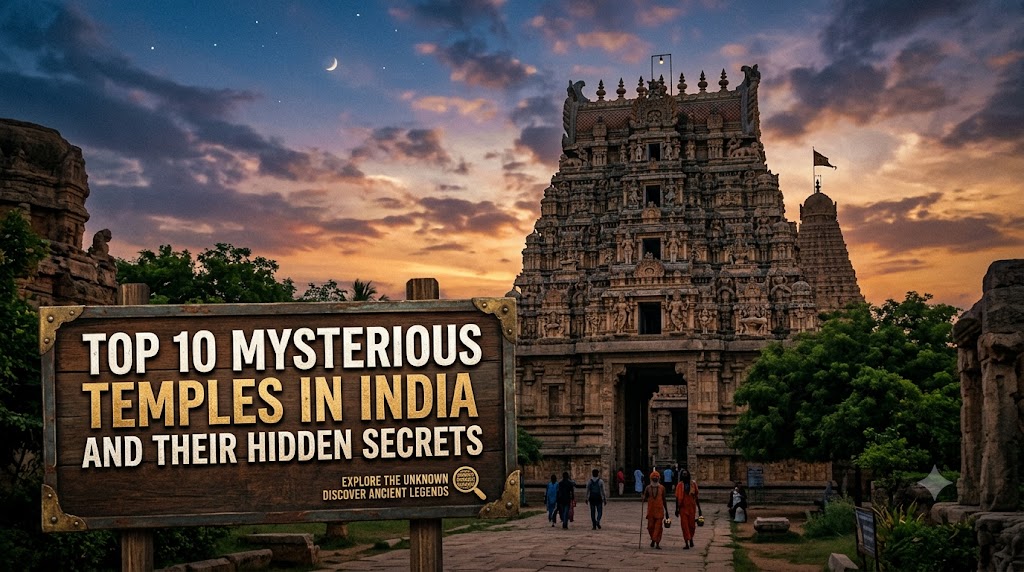
India is a country known for its rich history, diverse culture, and deep spiritual traditions. It is home to thousands of ancient temples, each with its own unique story, architectural beauty, and religious importance. While many temples are famous for their history and devotion, some are surrounded by mysterious legends and unexplained phenomena that continue to fascinate people from around the world.
From hidden underground chambers and eternal flames to floating pillars and temples that disappear under the sea, these sacred places have puzzled historians, scientists, and devotees for centuries. Some mysteries have scientific explanations, while others remain unsolved and are deeply connected to faith and ancient beliefs.
In this article, we will explore the Top 10 Mysterious Temples in India and Their Hidden Secrets. Discover the fascinating history, myths, and incredible facts behind these mysterious temples that make them some of the most unique and intriguing places in India.
Best 10 Mysterious Temples in India
1. Padmanabhaswamy Temple, Kerala
The Padmanabhaswamy Temple, located in Thiruvananthapuram, Kerala, is one of the most famous and mysterious temples in India. Dedicated to Lord Vishnu, the temple is known not only for its beautiful architecture and religious importance but also for its hidden underground vaults filled with priceless treasures. After several vaults were opened in 2011, gold, precious jewels, ancient ornaments, and valuable artifacts worth billions of dollars were discovered, making it one of the richest temples in the world.
Hidden Secret about Padmanabhaswamy Temple
The hidden secret about Padmanabhaswamy Temple is the mysterious Vault B, which remains sealed even today. According to temple traditions and local beliefs, this sacred chamber is protected by divine powers and should not be opened without performing specific religious rituals. Many devotees believe that opening the vault without following these rituals could bring misfortune or disaster.
Although experts have studied the temple for many years, Vault B has never been opened, making it one of India’s greatest unsolved temple mysteries. This fascinating hidden secret about Padmanabhaswamy Temple continues to attract historians, archaeologists, researchers, and millions of curious visitors from around the world.
2. Kamakhya Temple, Assam
The Kamakhya Temple, located on the Nilachal Hills in Guwahati, Assam, is one of the most sacred and mysterious temples in India. It is one of the 51 Shakti Peethas and is dedicated to Goddess Kamakhya, a form of Goddess Shakti. Every year, thousands of devotees and tourists visit this ancient temple to seek blessings and witness its unique traditions.
Hidden Secret of Kamakhya Temple
The biggest secret of Kamakhya Temple is that there is no idol of Goddess Kamakhya inside the temple. Instead, devotees worship a naturally formed rock, which is continuously fed by an underground spring and is believed to symbolize Goddess Shakti.
Another fascinating secret of Kamakhya Temple is the Ambubachi Mela, celebrated every year during the monsoon season. According to Hindu beliefs, the Goddess undergoes her annual menstrual cycle during this period. The temple remains closed for three days, and many devotees believe that the sacred spring water inside the temple turns reddish. After the temple reopens, thousands of pilgrims gather to receive the blessed Ambubachi Prasad (red cloth), which is considered highly sacred.
While many devotees believe these events are divine miracles, others see them as natural phenomena. Regardless of different viewpoints, the secret of Kamakhya Temple continues to fascinate historians, researchers, spiritual seekers, and devotees from across the world.
3. Jwalamukhi Temple, Himachal Pradesh
The Jwalamukhi Temple, located in Kangra district of Himachal Pradesh, is one of the most famous and mysterious temples in India. Dedicated to Goddess Jwala Devi, this ancient temple is unique because there is no traditional idol inside the sanctum. Instead, devotees worship the natural flames that have been burning continuously for centuries.
Hidden Secret About Jwalamukhi Temple
The biggest secret of Jwalamukhi Temple is its eternal blue flames, which emerge naturally from small cracks in the rocks. These flames have been burning continuously for hundreds of years without any visible source of fuel, making the temple one of India’s most mysterious and sacred places.
Scientists believe the flames are caused by natural gas emissions from beneath the earth. However, millions of devotees believe they are a divine manifestation of Goddess Jwala Devi and symbolize her eternal presence.
Despite several scientific studies and investigations, the exact reason behind these everlasting flames remains unknown. This fascinating mystery of Jwalamukhi Temple continues to attract devotees, historians, researchers, and travelers, making it one of the most mysterious religious sites in India.
4. Veerabhadra Temple, Lepakshi (Andhra Pradesh)
The Veerabhadra Temple, located in Lepakshi, Andhra Pradesh, is one of India’s finest examples of Vijayanagara architecture. Built in the 16th century, the temple is dedicated to Lord Veerabhadra, a fierce form of Lord Shiva. It is famous for its beautiful carvings, impressive murals, and remarkable engineering that continue to amaze visitors.
Hidden Secret about Veerabhadra Temple
The biggest secret of Veerabhadra Temple is its famous hanging pillar, also known as the floating pillar. Among the temple’s many stone pillars, one pillar does not completely touch the ground. Visitors can easily pass a thin cloth or a sheet of paper underneath it, proving that it is slightly suspended above the floor.
Experts believe this remarkable pillar is an excellent example of ancient Indian engineering and architectural brilliance. Although many researchers have studied it over the years, the exact technique used to construct and support the hanging pillar remains unknown. This fascinating secret of Veerabhadra Temple continues to attract tourists, architects, engineers, historians, and curious visitors from around the world.
5. Jagannath Temple, Odisha
The Jagannath Temple in Puri, Odisha, is a world-renowned Hindu temple dedicated to Lord Jagannath and is considered one of the holiest pilgrimage sites in India. Dedicated to Lord Jagannath, an incarnation of Lord Vishnu, the temple attracts millions of devotees every year, especially during the world-famous Rath Yatra (Chariot Festival). Besides its religious significance, the temple is also known for several fascinating mysteries that continue to amaze visitors.
Hidden Secrets about Jagannath Temple
The Secrets of Jagannath Temple have fascinated devotees, historians, and researchers for centuries. This sacred temple is surrounded by several unexplained phenomena that continue to amaze visitors from around the world. Some of the most well-known Secrets of Jagannath Temple include:
- The temple flag is believed to flutter in the opposite direction of the wind.
- Birds and aircraft are rarely seen flying directly above the temple, making it one of its most intriguing mysteries.
- The temple’s massive kitchen prepares Mahaprasad for thousands of devotees every day, yet it is believed that the food never falls short or goes to waste.
- The Sudarshan Chakra placed on top of the temple appears to face visitors from every direction, regardless of where they stand.
While some of these mysteries may have scientific explanations, many devotees believe they are divine miracles associated with Lord Jagannath. These remarkable Secrets of Jagannath Temple continue to attract pilgrims, history enthusiasts, and curious travelers, making it one of the most mysterious temples in India.
6. Brihadeeswarar Temple, Tamil Nadu
The Brihadeeswarar Temple, located in Thanjavur, Tamil Nadu, is one of India’s most famous ancient temples. Built over 1,000 years ago by Raja Raja Chola I, this magnificent temple is dedicated to Lord Shiva and is recognized as a UNESCO World Heritage Site.
Hidden Secret about Brihadeeswarar Temple
One of the biggest mysteries of the Brihadeeswarar Temple is its tower (Vimana), which rises to a height of about 66 meters (216 feet). It is widely believed that the tower casts little to no visible shadow on the ground at certain times of the day, making it one of the temple’s most fascinating features.
The temple was built entirely from massive granite stones, even though there are no granite quarries nearby, which adds to its mystery. Historians and engineers still admire the incredible architectural skills of the Chola dynasty, making the Brihadeeswarar Temple one of India’s greatest engineering and architectural wonders.
7. Stambheshwar Mahadev Temple, Gujarat
The Stambheshwar Mahadev Temple, located near the Arabian Sea in Gujarat, is one of the most unique and mysterious temples in India. Dedicated to Lord Shiva, this temple is famous for a remarkable natural phenomenon that attracts thousands of devotees and tourists every year.
Hidden Secret about Stambheshwar Mahadev Temple
The biggest mystery of this temple is that it disappears under the sea twice every day during high tide. As the water level rises, the temple is completely submerged beneath the seawater. When the tide recedes, the temple reappears without any damage, allowing devotees to offer prayers once again.
Many devotees believe this daily event is a divine blessing from Lord Shiva, making the Stambheshwar Mahadev Temple one of the most fascinating and Secret of Stambheshwar Mahadev Temple in India.
8. Mehandipur Balaji Temple, Rajasthan
The Mehandipur Balaji Temple, located in Dausa district, Rajasthan, is one of the most mysterious temples in India. Dedicated to Lord Hanuman (Balaji), the temple is famous for its unique spiritual healing rituals. Every year, thousands of devotees visit this sacred place seeking relief from negative energies and spiritual disturbances.
Hidden Secret about Mehandipur Balaji Temple
The biggest Secret of Mehandipur Balaji Temple lies in its unique spiritual healing rituals. Many devotees believe that these special prayers and traditional rituals help free people from negative energies and evil spirits. The temple priests have been performing these sacred rituals for generations, attracting thousands of visitors seeking spiritual peace and healing.
While many devotees consider these practices to be a divine miracle, others believe they may have psychological or cultural explanations. Regardless of different viewpoints, the Secret of Mehandipur Balaji Temple continues to fascinate devotees, researchers, and curious travelers, making it one of the most mysterious religious places in India.
9. Konark Sun Temple, Odisha
The Konark Sun Temple, located in Odisha, is one of India’s most famous ancient temples and a UNESCO World Heritage Site. Built in the 13th century, the temple is dedicated to the Sun God (Surya) and is designed in the shape of a giant stone chariot with beautifully carved wheels and horses. Its remarkable architecture continues to attract visitors from around the world.
Hidden Secret about Konark Sun Temple
One of the biggest Secrets of Konark Sun Temple is the legend of a powerful magnetic stone that was once placed at the top of the temple. According to popular beliefs, this magnet was so strong that it could affect the compasses of ships sailing near the Odisha coast, making navigation difficult for sailors.
Although there is no conclusive historical evidence to confirm this story, the legend has been passed down through generations. This fascinating Secret of Konark Sun Temple continues to attract historians, researchers, and travelers, making it one of the most mysterious and intriguing temples in India.
10. Nidhivan, Vrindavan (Uttar Pradesh)
Nidhivan, located in Vrindavan, Uttar Pradesh, is one of the most mysterious and sacred places associated with Lord Krishna and Radha Rani. Although it is not a traditional temple, it holds great religious significance and attracts thousands of devotees and spiritual seekers every year.
Hidden Secret about Nidhivan
The biggest Secret is Nidhivan is the belief that Lord Krishna and Radha Rani perform the divine Raas Leela every night after the temple closes. According to local traditions, no person, animal, or bird remains inside the premises after sunset, as the place is considered sacred during the night.
Many locals also believe that anyone who attempts to witness these divine events may lose their mental balance or face unfortunate consequences. While there is no scientific evidence to support these beliefs, the Secret about Nidhivan has fascinated devotees, historians, and spiritual seekers for centuries, making it one of the most mysterious and sacred places in India.
Why are these Temples So Mysterious?
India’s ancient temples have fascinated people for centuries because of their unique architecture, unexplained events, and ancient legends. While some mysteries have scientific explanations, many are still connected to faith, mythology, and local traditions. These temples continue to attract devotees, historians, researchers, and travelers from around the world.
Some of the main reasons why these temples are considered mysterious include:
- Amazing ancient architecture and engineering.
- Mythological stories passed down through generations.
- Unexplained natural phenomena that many believe are miracles.
- Hidden chambers and underground structures.
- Centuries-old religious rituals and traditions.
- Historical mysteries that are still unsolved.
Some of these mysteries may be explained by science in the future, while others remain an important part of India’s spiritual heritage and cultural beliefs.
Faith and Science: Two Different Perspectives
The mysteries of Indian temples are viewed in different ways by devotees and researchers. For millions of people, these sacred places are symbols of divine power, miracles, and deep faith. They believe that many of the unexplained events are blessings of the gods and have spiritual significance.
On the other hand, historians, archaeologists, and scientists try to understand these mysteries through research, history, architecture, geology, and scientific studies. They look for logical explanations behind the unique features of these ancient temples.
Whether you believe in faith or science, these mysterious temples continue to inspire curiosity and attract millions of visitors every year. Their rich history, remarkable architecture, and fascinating legends make them some of the most extraordinary places in India.
Frequently Asked Questions (FAQs)
1. Which is the most mysterious temple in India?
Answer: The Padmanabhaswamy Temple is famous for its hidden underground chambers and the mysterious Vault B, which remains sealed. This unsolved mystery has made it one of the most intriguing temples in India.
2. Which temple is famous for its eternal flame?
Answer: The Jwalamukhi Temple in Himachal Pradesh is famous for its eternal blue flames, which have been burning naturally for centuries without any visible fuel source.
3. Which temple disappears under the sea every day?
Answer: The Stambheshwar Mahadev Temple in Gujarat is submerged under seawater during high tide and reappears when the tide recedes, making it one of India’s most unique temples.
4. Why is the Kamakhya Temple so unique?
Answer: The Kamakhya Temple is unique because there is no idol of the Goddess. During the annual Ambubachi Mela, it is believed that Goddess Kamakhya undergoes her yearly menstrual cycle, making the temple one of the most sacred Shakti Peethas in India.
5. Are the mysteries of these temples scientifically proven?
Answer: Some mysteries have scientific explanations, while others are based on religious beliefs, local traditions, and historical legends. Many of these fascinating mysteries continue to be studied and debated by researchers and devotees alike.
Conclusion
India’s mysterious temples are much more than architectural wonders—they are living symbols of the country’s spiritual traditions, mythology, and cultural heritage. From hidden vaults and eternal flames to submerged shrines and unexplained architectural marvels, these sacred sites continue to captivate both believers and researchers.
Whether you visit them as a devotee, history enthusiast, or curious traveler, each temple offers a unique glimpse into India’s rich past and enduring mysteries. While science may explain some of these phenomena in the future, many secrets remain intertwined with faith, legend, and centuries-old traditions, ensuring that these remarkable temples continue to inspire wonder for generations to come.