Kargil Vijay Diwas 2026: Date, History, Significance, Heroes & Celebrations

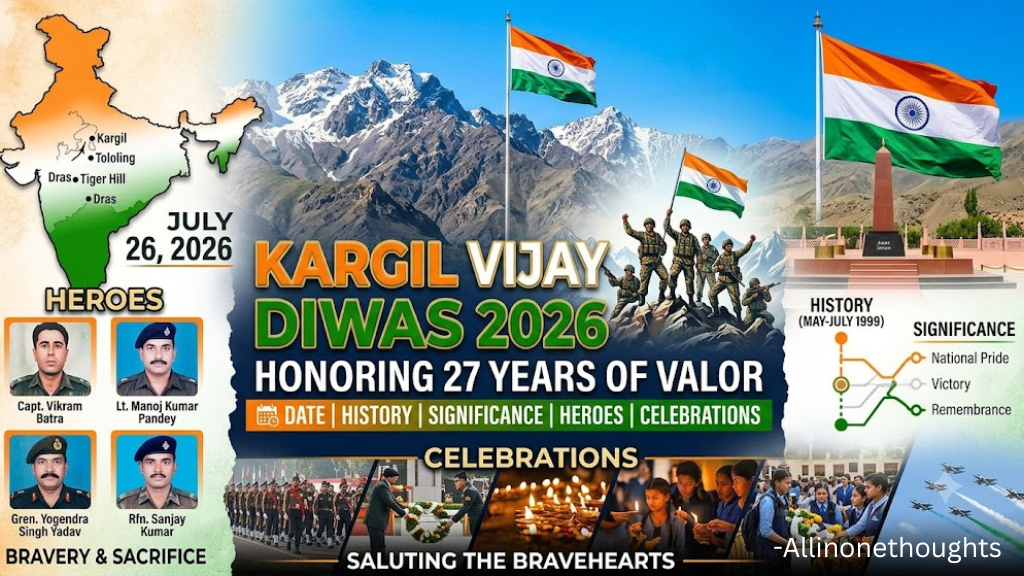
Every year on 26 July, India celebrates Kargil Vijay Diwas to honor the courage, sacrifice, and patriotism of the brave soldiers who fought in the 1999 Kargil War. This day reminds every Indian of the unwavering dedication of the Indian Armed Forces in protecting the nation’s sovereignty.

Kargil Vijay Diwas 2026 marks the 27th anniversary of India’s historic victory in the Kargil War. It is a day to remember the heroes who made the ultimate sacrifice and to pay tribute to the soldiers whose bravery led India to victory during Operation Vijay.

In this article, you will learn everything about Kargil Vijay Diwas 2026, including the official date, history, significance, background of the Kargil War, Operation Vijay, brave war heroes, how Kargil Vijay Diwas is celebrated, and inspiring Kargil Vijay Diwas quotes.

What is the Kargil Vijay Diwas 2026 Date?

Kargil Vijay Diwas 2026 will be observed on Sunday, 26 July 2026. The day marks the 27th anniversary of India’s historic victory in the 1999 Kargil War.

Kargil Vijay Diwas 2026 – Key Highlights

  • Date: Sunday, 26 July 2026
  • Occasion: 27th anniversary of India’s victory in the Kargil War.
  • Operation Vijay: Launched in May 1999 by the Indian Armed Forces to drive out Pakistani intruders from Indian territory.
  • Victory Day: On 26 July 1999, the Indian Army successfully recaptured all occupied positions, leading to India’s victory.
  • National Importance: Every year, 26 July is observed to honor the courage, sacrifice, and dedication of the brave soldiers who fought in the Kargil War.
  • Why We Celebrate: Kargil Vijay Diwas is a tribute to the heroes who protected India’s sovereignty. It symbolizes bravery, patriotism, national unity, and the unwavering commitment of the Indian Armed Forces to defend the nation.

Background of the Kargil War

To understand the history of Kargil Vijay Diwas, it is important to know how the Kargil War began.

In February 1999, India and Pakistan signed the Lahore Declaration, an agreement aimed at improving peace and strengthening relations between the two countries. However, despite these peace efforts, the conflict soon escalated.

During the winter of 1998–1999, Pakistani soldiers and armed infiltrators crossed the Line of Control (LoC) and secretly occupied several high-altitude Indian positions in the Kargil, Dras, Batalik, and Kaksar sectors of Jammu and Kashmir. Many of these posts had been temporarily vacated due to extreme winter conditions.

The infiltrators took control of strategic mountain peaks located at altitudes of 11,000 to 18,000 feet, posing a serious threat to India’s security and the vital National Highway 1A (NH-1A), which connected Srinagar to Leh.

After the intrusion was discovered, the Indian Armed Forces launched Operation Vijay in May 1999 to drive out the infiltrators and reclaim every occupied post. This military campaign eventually led to India’s historic victory on 26 July 1999, a day now celebrated every year as Kargil Vijay Diwas.

The Strategic Threat

The Pakistani infiltration was carefully planned with the goal of gaining a strategic advantage in the Kargil region. Their main objectives were:

1. Cut Off National Highway 1A (NH-1A)

The infiltrators occupied high mountain peaks overlooking National Highway 1A, the key road connecting Srinagar to Leh. Their aim was to disrupt this vital route and cut off Ladakh from the rest of Jammu and Kashmir.

2. Isolate Indian Troops in Siachen

By controlling the highway and surrounding areas, Pakistan intended to disrupt the supply of food, ammunition, and essential resources to Indian soldiers stationed at the Siachen Glacier, making their operations much more difficult.

3. Gain an Advantage in the Kashmir Dispute

Pakistan hoped that by capturing these strategic positions, it could put military and diplomatic pressure on India and strengthen its position in future discussions over the Kashmir issue.

However, the Indian Armed Forces responded with courage and determination through Operation Vijay, successfully recapturing all occupied positions and defeating the infiltrators.

History of Kargil Vijay Diwas

The history of Kargil Vijay Diwas dates back to May 1999, when local shepherds in the Batalik region noticed suspicious movements in the mountains and informed the Indian Army. After investigation, it was discovered that Pakistani soldiers and infiltrators had secretly occupied several strategic Indian posts along the Line of Control (LoC).

Timeline of the Kargil War

[May 1999: Infiltration Discovered]


[Launch of Operation Vijay]


[Joint Operations: Army, Navy & Air Force]


[July 26, 1999: Reclaiming Peak Points & Victory]

To remove the infiltrators, the Government of India launched Operation Vijay, deploying more than 2,00,000 Indian soldiers. The battle was fought in extremely difficult conditions, with soldiers climbing steep mountains at altitudes of 11,000–18,000 feet, often in freezing temperatures and under heavy enemy fire.

The Indian Air Force supported the mission through Operation Safed Sagar, carrying out precision air strikes against enemy positions. At the same time, the Indian Navy launched Operation Talwar, increasing pressure on Pakistan by strengthening its naval presence in the Arabian Sea.

During the war, Indian soldiers displayed extraordinary courage and successfully recaptured several important peaks, including Tololing, Tiger Hill, and Point 4875.

On 26 July 1999, the Indian Armed Forces successfully drove the remaining Pakistani intruders back across the Line of Control (LoC). This decisive victory is remembered every year as Kargil Vijay Diwas, honoring the bravery, sacrifice, and patriotism of India’s armed forces.

Why Do We Celebrate Kargil Vijay Diwas?

Kargil Vijay Diwas is celebrated every year on 26 July to honor the courage, sacrifice, and dedication of the brave Indian soldiers who fought in the 1999 Kargil War. The day pays tribute to the 527 soldiers who made the ultimate sacrifice while protecting India’s sovereignty and territorial integrity.

Importance of Kargil Vijay Diwas

1. Honors Brave Soldiers
Pays tribute to the 527 Indian soldiers who sacrificed their lives for the nation.

2. Protects India’s Sovereignty
Celebrates India’s determination to defend its borders and territorial integrity.

3. Historic Military Victory
Recognizes the success of one of the world’s toughest high-altitude military operations.

4. Promotes Patriotism
Inspires national unity, pride, and respect for the Indian Armed Forces.

5. Symbol of Courage
Highlights the bravery, discipline, and dedication of the soldiers who protected the country.

Kargil Vijay Diwas is a proud reminder of India’s courage, sacrifice, and unwavering commitment to safeguarding the nation.

Heroes of the Kargil War - Highlights

The victory of the Kargil War was written in the blood of young, extraordinary military officers and jawans who put the country before self. Here are the highlights of some of the immortal heroes of the Kargil War:

1. Captain Vikram Batra (Param Vir Chakra, Posthumous)

Known affectionately as the “Sher Shah” of Kargil, Captain Batra of the 13 Jammu and Kashmir Rifles became the face of Indian resilience. His famous victory slogan, “Yeh Dil Maange More!”, echoed across the nation. He courageously led the recapture of Point 5140 and was killed in action while rescuing a fellow officer during the capturing of Point 4875.

2. Lieutenant Manoj Kumar Pandey (Param Vir Chakra, Posthumous)

Belonging to the 1/11 Gorkha Rifles, Lieutnant Pandey was driven by a single-minded goal: to serve the nation at all costs. During the assault on Khalubar hills, he pushed forward through a hail of bullets, clearing multiple enemy bunkers before succumbing to fatal injuries. His dying words continued to inspire his men to secure the peak.

3. Subedar Major Yogendra Singh Yadav (Param Vir Chakra)

As a 19-year-old Grenadier, Yogendra Singh Yadav volunteered to climb the vertical, ice-clad cliff of Tiger Hill. Despite being struck by multiple bullets, he crawled forward, lobbed grenades into enemy bunkers, and cleared the way for his platoon, cementing the capture of Tiger Hill.

4. Rifleman Sanjay Kumar (Param Vir Chakra)

Rifleman Sanjay Kumar showed extraordinary grit during the assault on Flat Top of Point 4875. When his scouting team faced heavy automatic fire, he charged the enemy sangar head-on, engaged in hand-to-hand combat, and turned the enemy’s own machine gun against them to secure the area.

Lest We Forget:

India will always remember the extraordinary courage and sacrifice of heroes like Major Rajesh Adhikari, Captain Saurabh Kalia, Squadron Leader Ajay Ahuja, and the hundreds of brave soldiers who laid down their lives during the Kargil War. Their selfless service, unwavering dedication, and supreme sacrifice continue to inspire every Indian and remind us that our freedom exists because of their courage.

How Kargil Vijay Diwas Is Celebrated

Every year on 26 July, Kargil Vijay Diwas is celebrated across India to honor the bravery and sacrifice of the Indian Armed Forces. People pay tribute to the heroes of the Kargil War through various national and local events.

1. Tribute at the Kargil War Memorial, Dras

The main ceremony is held at the Kargil War Memorial in Dras, Ladakh. Senior government leaders, military officers, and the families of the martyrs pay floral tributes to the brave soldiers. The event also includes military ceremonies and patriotic programs.

2. Homage at the National War Memorial

In New Delhi, the President, Prime Minister, Defence Minister, and senior military officials pay tribute at the National War Memorial by laying wreaths in memory of the fallen soldiers.

3. Patriotism Through Public Events

Across the country, marathons, rallies, bicycle rides, and patriotic programs are organized to remember the sacrifices of the Kargil heroes and inspire the younger generation.

4. School and College Programs

Schools, colleges, and educational institutions conduct essay writing, speech competitions, patriotic songs, poetry recitals, and cultural performances to educate students about the Kargil War and the courage of Indian soldiers.

5. Online Tributes and Social Media

People also celebrate Kargil Vijay Diwas by sharing patriotic messages, quotes, videos, and stories of the war heroes on social media, expressing gratitude to the Indian Armed Forces.

Kargil Vijay Diwas is not only a day to remember India’s victory but also an opportunity to salute the courage, sacrifice, and dedication of the soldiers who protect the nation.

Inspiring Kargil Vijay Diwas Quotes

Sharing words of pride is a beautiful way to spread awareness about Kargil Vijay Diwas. Here are some moving Kargil Vijay Diwas quotes to share on social media:

  • “Either I will come back after hoisting the Tricolour, or I will come back wrapped in it, but I will be back for sure.” – Captain Vikram Batra
  • “Our flag does not fly because the wind moves it; it flies with the last breath of each soldier who died protecting it.”
  • “The brave die never, though they sleep in dust: Their courage nerves a thousand living men.”
  • “Freedom is not free. It is bought with the blood, sweat, and tears of our soldiers. Salute to the heroes of Operation Vijay!”
  • “Shaheedon Amar Raho! Kargil Vijay, Amar Rahe!”

Final Thoughts:

The Eternal Flame of Valor Kargil Vijay Diwas 2026 is not just another day on the calendar; it is a profound testament to what India stands for—unity, courage, honor, and an uncompromising stance on sovereignty. The dynamic heights of Kargil showed the world that when the homeland is threatened, the citizens and soldiers of India stand as an impenetrable wall.

As we celebrate this day, let us take a moment to thank the men and women in uniform who brave extreme climates and hostile conditions every single day so that we can sleep in peace.

Jai Hind! Jai Bharat!

Frequently Asked Questions (FAQs)

Q1. Why is it called Operation Vijay?
Ans: Vijay translates to “Victory” in Hindi. The Indian Armed Forces named the counter-offensive mobilization “Operation Vijay” to reflect their ultimate objective: completely reclaiming Indian territory and securing a decisive victory.

Q2. How long did the Kargil War last?
Ans: The Kargil War lasted for roughly 60 days, beginning in early May 1999 and officially concluding on July 26, 1999.

Q3. Can civilians visit the Kargil War Memorial in Dras?
Ans: Yes. The Kargil War Memorial in Dras, Ladakh, is open to the public. It features a museum filled with war photographs, seized Pakistani weapons, and a memorial wall inscribed with the names of all the fallen heroes.

Share and Enjoy !

Shares
We will be happy to hear your thoughts

Leave a reply

All In One Thoughts
Logo